The CHRO Visibility Gap
Why the most consequential workforce decisions in a decade are being made without the data to make them well, and what closes the gap.
In this paper
The decisions are too big to get wrong.
CHROs are being asked to restructure organizations, deploy AI at scale, defend headcount decisions to boards, and anticipate who is about to walk out the door. All of this is happening simultaneously, while the ground shifts underneath them. Heads of Talent Acquisition face parallel pressure: scaling hiring for growth, proving quality of hire, and reducing time-to-productivity, often with pipelines that outpace the organization’s ability to absorb and ramp new talent.
The problem is not a failure of leadership. It is a failure of data. Most HR and TA functions are navigating the most consequential workforce decisions in a decade using information collected twice a year, filtered through manager perception, and delivered weeks after it was actually needed.
organizations expect AI-drivenworkforce reductions, yet only 15% do strategic workforce planning today
of orgs are using AI tools but most still in pilot, with no way to measure actual adoption or productivity impact
Voluntary attrition costs 2× annual salary. CHROs rarely see the behavioral signals early enough to intervene.
These are not data gaps that HR can afford to close gradually. Restructurings, AI investments, RTO mandates, and headcount freezes are happening now. Every one of those decisions is being made with incomplete information.
What HR can see vs. what’s actually happening
Traditional HR data tells you what already happened. Surveys capture sentiment, not behavior. Performance reviews
reflect manager perception more than actual output. HRIS tells you where people sit on the org chart, but nothing about
how they are actually working.
CHROs who cannot show data-backed team structures are flying blind during the most consequential decisions of their tenure.
How work actually reveals itself
Prodoscore connects via API to the tools your workforce already uses, including Microsoft 365, Google Workspace,
Salesforce, Jira, UCaaS platforms, and AI productivity tools. There is nothing new for employees to install or adopt, and
nothing that resembles surveillance.
Prodoscore is non-invasive by design. API-based, no screenshots, no surveillance. It deploys in days and delivers insights HR business partners can act on without a data science team. Customers see an average 20% productivity increase within four months.
10 use cases. 6 strategic HR domains.
Prodoscore closes the visibility gap across the full CHRO agenda. Each use case delivers a continuous, objective signal in exactly the domain where HR is being asked to act.
Restructure teams based on how work actually flows, not org charts
or headcount spreadsheets.
See where teams are structurally overloaded before attrition surfaces
the problem.
Build a data-driven picture of AI readiness across the workforce to
inform upskilling investment.
Go beyond training completion rates. See who is using AI, how
effectively, and where spend is wasted.
Replace recency bias and manager perception with a continuous, fair
behavioral signal.
Identify the behavioral patterns that predict high performance, then
build hiring models around them.
Measure how quickly new hires ramp to productivity and identify the
onboarding patterns that accelerate time-to-value.
Surface sustained overload — after-hours trends, collaboration dropoff
— before it becomes a retention problem.
Detect behavioral signal changes 6–8 weeks before an employee
disengages, while there is still time to intervene.
Replace mandate-vs.-pushback with objective productivity data
across work locations and team configurations.
Burnout doesn’t announce itself. Signals do.
By the time an employee resigns citing burnout, the organization has already paid the price. The behavioral signals — sustained after-hours activity, meeting overload, collaboration network contraction — appear weeks before that point. Prodoscore reads them on a continuous basis.
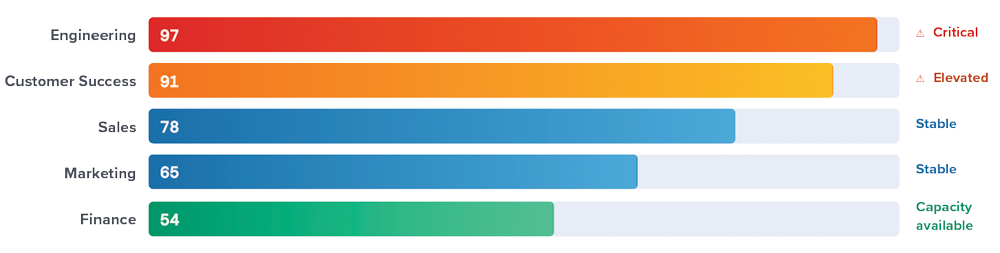
Engineering and Customer Success had been running above 90 on the workload index for 11 consecutive weeks. Three senior managers were showing early signs of behavioral disengagement — after-hours activity declining and cross-functional collaboration dropping. HR presented a data-backed case: two targeted hires at $80K combined, weighed against a modeled retention risk of $620K if one senior manager were to exit. Both hires were approved in the next budget cycle.
Sustained overload detected before any attrition
Modeled retention risk that framed the hiring case
Board approval rate when data anchors the ask
Flight risk surfaces 6–8 weeks early.
Attrition is expensive. Replacing a senior employee typically costs between 1.5 and 2 times their annual salary, and most organizations do not see it coming. Prodoscore detects the behavioral precursors — disengagement from collaboration networks, reduced tool activity, and shifts in work patterns — while there is still time to intervene.
| Employee | Flight Risk | Signal | Status |
|---|---|---|---|
| M. Okonkwo · Eng Lead |
87
|
Collaboration down 34% · After-hours work stopped entirely · No response to 3 Slack pings over 2 days | Intervene now |
| A. Reyes · Sr. CSM |
61
|
Meeting attendance declining · Salesforce activity flat for 3 weeks · Skipped 2 team syncs | Monitor closely |
| T. Nakamura · PM |
48
|
Productivity stable but cross-team collaboration contracting · Less Jira activity than 60-day avg | Watch |
| J. Carter · AE |
19
|
High activity · Strong collaboration patterns · Consistent with top-performer baseline | Stable |
These scores are not generated from a survey. They are derived from live behavioral data across every email sent, every meeting attended, and every tool interaction, updated continuously and surfaced to HR and managers while the window to act is still open.
You can’t manage AI adoption you can’t measure.
88% of organizations are using AI tools, yet most have no reliable way to know whether employees are actually using them, whether usage translates to productivity, or whether the AI tool budget is generating any meaningful return. Training completion rates are not the same thing as adoption.
| WITHOUT PRODOSCORE | WITH PRODOSCORE |
|---|---|
| Training completion is 74%. The CHRO reports strong AI adoption progress. | The Sales team shows 28% daily active users, with 138 employees who have never opened the tool. Budget allocation is fundamentally misaligned with actual adoption. |
| AI-generated content is being sent to clients without human review. Three client complaints have been filed and the root cause remains unknown. | Workflow pattern analysis identifies 14 Sales users bypassing the review step. The intervention targets that specific workflow rather than a company-wide mandate. |
| Executives report low AI usage. HR attributes it to seniority and does not escalate. | Adoption drops with seniority even when training completion rates are high. HR surfaces the pattern directly: you cannot drive transformation while the people leading it are not using the tools. |
Hiring fast isn’t the problem. Hiring right is.
Rapidly scaling organizations hire ahead of need, then spend months discovering whether each new hire was actually the right one. By the time a quality-of-hire signal surfaces through a manager’s annual review, the cost of a bad fit is already embedded.
One AE cohort reached productivity parity at 38 days; another averaged 74. The difference traced to a single variable: early Salesforce and CRM tool engagement in week one. TA updated the onboarding checklist and coached hiring managers to prioritize tool immersion in the first week. The next cohort averaged 41 days to full productivity.
Reduction in time-to-productivity across next
cohort
Best-cohort ramp time — now the repeatable
benchmark
Week-one tool engagement predicted full-ramp
trajectory
The layer no one else has built yet.
HCM systems know who your people are. Workforce analytics platforms know how they are organized. None of them can tell you how work actually flows inside your organization on any given day. Prodoscore owns the digital signals layer —the only source of continuous, behavioral, activity-level intelligence from the tools your workforce already uses.
Real-Time, Not Retrospective
Data is continuous and current rather than collected quarterly. By the time survey results arrive, the window to act has often already closed.
Behavioral, Not Reported
Activity signals come from actual work tools rather than self-reported surveys, manager ratings, or HR system records. This reflects how work actually happens.
Actionable by HR
No data science team is required. Insights are designed for HR business partners and managers, not analysts. The platform deploys in days rather than months.
Non-Invasive by Design
API-based integration only — no screenshots, no keystroke logging, no surveillance. Prodoscore is built to earn employee trust rather than undermine it.
Integrates the Full Stack
Works alongside your existing HRIS, ATS, engagement platform, and workforce analytics tools, adding the behavioral layer that completes the picture.
ROI Verified
Customers see an average 20% productivity increase within four months. Outcome-based measurement is built into the platform from
the start.